
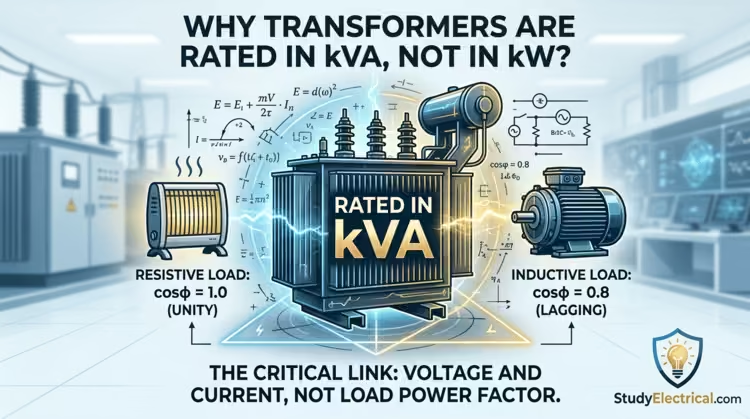
Quick Summary (TL;DR): > Transformers are rated in Volt-Amperes (kVA) because their internal losses (Iron and Copper losses) are determined solely by the operating voltage ($V$) and load current ($A$), entirely independent of the load’s power factor ($\cos\theta$). Because a transformer manufacturer cannot predict whether a consumer will connect a purely resistive, inductive, or capacitive load, the machine must be rated by its apparent power capability, not its active power output (kW).
Introduction: Apparent Power vs. Active Power
To understand why a transformer’s rating is designated in kVA (Kilovolt-Amperes) rather than kW (Kilowatts), we must look at the nature of alternating current (AC) power.
- kVA (Apparent Power): The total electrical power delivered to a circuit ($V \times I$).
- kW (Active / Real Power): The actual power performing useful work ($V \times I \times \cos\theta$).
Where $\cos\theta$ is the Power Factor (PF) of the connected load. A transformer is a passive device that merely transfers power from the primary circuit to the secondary circuit. It does not generate or alter the phase angle between voltage and current—the load dictates that.
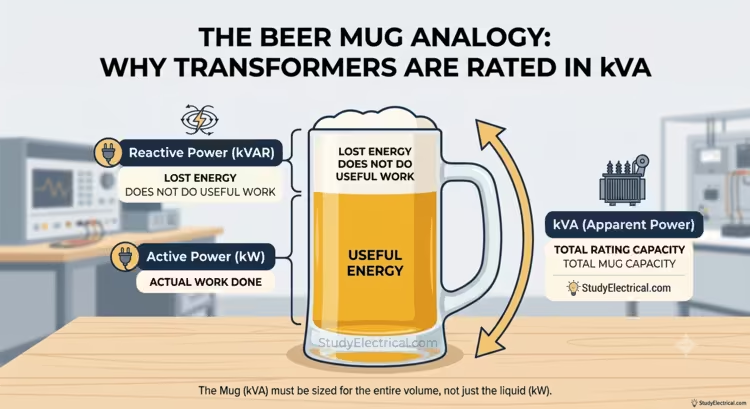
The Core Reason: Transformer Losses and Temperature Rise
The absolute maximum rating of any electrical machine is constrained by its thermal limit (the point where heat destroys winding insulation). In a transformer, this temperature rise is directly caused by two primary types of power losses:
A. Core Losses (Iron Losses)
- Cause: Caused by alternating magnetic flux in the transformer’s steel core (Hysteresis and Eddy current losses).
- Dependency: Core loss depends directly on the applied Voltage ($V$) and supply frequency. It remains constant from no-load to full-load condition.$$\text{Iron Loss} \propto \text{Voltage } (V)$$
B. Copper Losses ($I^2R$ Winding Losses)
- Cause: Caused by the electrical resistance of the primary and secondary copper windings.
- Dependency: Copper loss is variable and depends strictly on the square of the Current ($I$) passing through the windings.$$\text{Copper Loss} \propto I^2R \propto \text{Current } (I)$$
Why this matters:
Because total losses equal $\text{Iron Losses (dependent on } V) + \text{Copper Losses (dependent on } I)$, the total heat generated inside the transformer depends completely on the product of Volt-Amperes ($V \times I$). The phase angle ($\theta$) between the voltage and current has absolutely no impact on these internal losses.
Mathematical Proof: The Changing Load Scenario
Let us look at a practical engineering example to understand why transformers are rated in kVA. Consider a single-phase transformer rated for 10 kVA at 240V.
The maximum safe current the winding conductors can handle is:
$$I = \frac{\text{kVA} \times 1000}{V} = \frac{10 \times 1000}{240} \approx 41.67\text{ A}$$
Now, let’s connect two completely different loads to this transformer to see how its kilowatt output changes while its internal stress remains exactly identical:
| Parameter | Case 1: Purely Resistive Load (Heaters) | Case 2: Inductive Load (Motors) |
| Power Factor ($\cos\theta$) | $1.0$ (Unity) | $0.8$ (Lagging) |
| Voltage ($V$) | $240\text{ V}$ | $240\text{ V}$ |
| Current ($I$) | $41.67\text{ A}$ | $41.67\text{ A}$ |
| Calculated kVA | $240 \times 41.67 = \mathbf{10\text{ kVA}}$ | $240 \times 41.67 = \mathbf{10\text{ kVA}}$ |
| Delivered kW Output | $10\text{ kVA} \times 1.0 = \mathbf{10\text{ kW}}$ | $10\text{ kVA} \times 0.8 = \mathbf{8\text{ kW}}$ |
| Winding Temperature Rise | Maximum Permissible Limit | Maximum Permissible Limit |
The Takeaway:
In both cases, the transformer reaches its absolute thermal and electrical limit because it is carrying $41.67\text{ A}$ at $240\text{ V}$. However, in Case 2, it is only delivering 8 kW of useful power. If the manufacturer had falsely rated this machine as a “10 kW transformer,” a user might try to draw 10 kW at a 0.8 power factor, requiring 52 A of current, which would overheat and burn out the windings.
Engineering Comparison: Why are Motors Rated in kW / HP?
A common interview question for electrical students is: If transformers are rated in kVA, why are electric motors rated in kW or Horsepower (HP)?
- Motors convert Electrical Energy to Mechanical Energy. The output is measured at the shaft in terms of physical work done (torque and speed). Therefore, it must be stated in real power units (kW or HP).
- Motors have a predetermined power factor. A motor is an inductive machine with a design structure that dictates its own typical power factor at full load. Conversely, a transformer doesn’t know what kind of load will be plugged into it.
Frequently Asked Questions (FAQs)
Q1: Can a transformer be operated above its rated kVA?
Only temporarily. Operating a transformer past its kVA rating forces higher current through the windings, scaling up the copper losses exponentially ($I^2R$). This causes rapid thermal degradation of the insulation material, significantly shortening the transformer’s lifespan.
Q2: Does the power factor affect transformer efficiency?
Yes. While the power factor doesn’t alter the transformer’s total capacity rating, running a transformer at a low power factor lowers the useful real power ($kW$) delivered to the system while keeping internal losses high. This translates to poorer overall system efficiency.
Q3: Are there any other AC machines rated in kVA?
Yes, Alternators (Synchronous Generators) are also rated in kVA/MVA for the identical reason. Their internal stator core losses depend on generated voltage, and their winding copper losses depend on output current, regardless of grid power factor.
Related posts:
 Percentage Impedance of Transformer and Its Calculation
 Transformer Bushing Types : RIP Bushing vs OIP Bushing
 How to Test Percentage Impedance of Transformer?
 Transformer Windings: Types and Design
 Advantages and Disadvantages of Transformers
 Delta-Delta (Δ–Δ) Transformer Connection: Advantages, Working, and Application
 Three-Phase Transformer Connections: Y–Y, Δ–Δ, Y–Δ, Δ–Y, V–V, T-T
 Beginner’s Guide to Separately Excited DC Generator
 Current Limiting Reactor or Series Reactor
 DC Motor Problems and Solution – Step by Step